
 Creative Spaces Network
Every Wednesday morning up to 45 people gather to sing in Christchurch. Some arrive in wheelchairs. Some live with communication or physical impairments. Others are carers, volunteers or family members. There is laughter, friendship, morning tea and, most importantly, music.
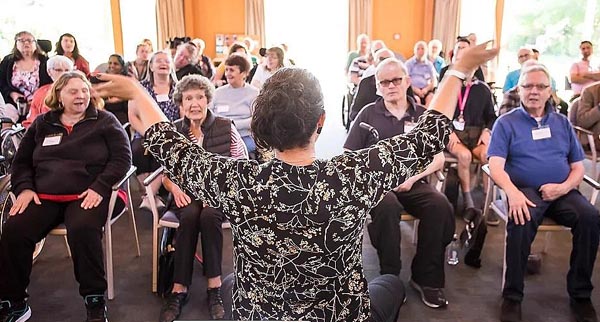 This is Cantabrainers City Choir, one of three therapeutic choirs run by the Cantabrainers Therapeutic Choir Trust and a member of the Creative Spaces Network, facilitated by Arts Access Aotearoa.
Alongside the City Choir are Cantabrainers North Canterbury and Connections Choir, run in partnership with Dementia Canterbury.
The choir began in 2012 when music therapist Kimberley Wade and speech-language therapist Susan Macdonald, supported by Shonagh O’Hagan from Therapy Professionals, combined their skills to create a choir for people living with neurological conditions such as stroke or brain injury.
“We talked to Alison Talmage about the CeleBRation Choir in Auckland and thought wow, let's combine the skills of speech therapy with music therapy and make this incredible choir,” Kimberley says.
Almost 15 years later, Kimberley still co-leads the City Choir while another music therapist therapist, May Clulee from Southern Music Therapy, co-leads the North Canterbury Choir. The collaboration between music therapy and speech-language therapy remains central to the way the choirs work.
More than a group of people who meet to sing
There’s plenty of enjoyment but Cantabrainers is not simply a group of people who meet to sing. “It’s not just a sing-along,” Kimberley says. “We’re very good at hiding the therapeutic benefits behind the enjoyment.”
The pace is slower than a conventional choir and the repertoire is chosen with members’ therapeutic needs in mind. Sessions are adapted according to who is in the room: for instance, how many words are used, how quickly the music moves, who is ready to sing a solo and how much harmony is introduced.
“Singing offers a powerful pathway back to communication for people whose voices or speech have been affected by neurological conditions,” Kimberley explains.
For Kimberley, the therapeutic possibilities of music became clear long before she established Southern Music Therapy in 2011. There’s a lot of music in her family, including her nana, who played music and did Scottish country dancing.
“When I was a child, Nana took me to sing to blind people and we would wear matching outfits. So I was working with music as a therapeutic tool from quite a young age.”
She trained as a classical singer and her accompanist was a music therapist. Then while she was studying classical music and psychology at university, she saw the possibilities of bringing the two subjects together.
“I thought, what is this profession that merges these two loves? It felt pretty awesome to find a profession that merges the psychology of people with this powerful tool that music can be.”
Southern Music Therapy celebrating 15 years
Southern Music Therapy, which is celebrating 15 years, has grown into a team of six music therapists and an office manager, with additional therapists subcontracted for particular projects.
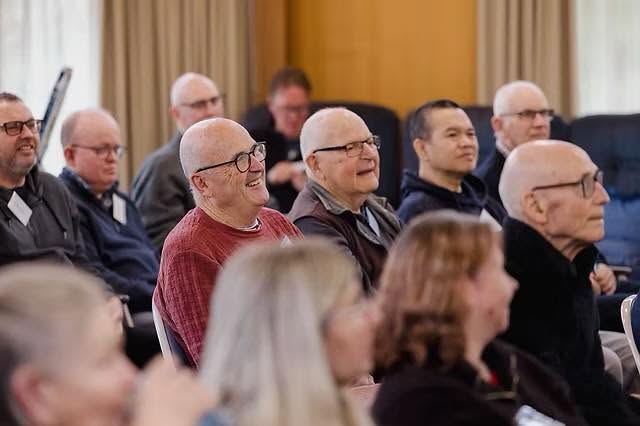 The practice works with children with physical and intellectual disabilities, people with neurological conditions and older adults with long-term health conditions. Its work ranges from rehabilitation to quality-of-life support and includes individual and group music therapy, neurologic music therapy, adapted music lessons, workshops and mentoring.
Kimberley says individual therapy can be a vital part of rehabilitation but it can also be difficult to access long-term because of cost and funding limitations. The choir complements therapy by providing an affordable, supportive space where people can continue developing communication skills, confidence and wellbeing through music – at the same time building meaningful social connections.
What began as a small group of singers has now grown into three thriving communities, she says.
It’s since become an organisation in its own right. In 2019, the Cantabrainers Therapeutic Choir Charitable Trust was set up to run the choirs, with Southern Music Therapy continuing its close therapeutic partnership.
Kimberley says belonging to the Creative Spaces Network is an important way to connect with a wider, national arts community. It also shows that spaces combining creativity, connection and wellbeing play a vital role in in the health and wellbeing of people in our communities.
Cantabrainers City Choir performs to the public twice a year and will combine with the North Canterbury Choir on 9 December for its annual Christmas concert.
“Cantabrainers Choir is the most incredible, joyful place. Sometimes I think, oh my goodness, do I have the energy for this today? And then a member will come in with a beautiful smile and say how excited they are that it’s a choir day."
She recalls one song in which choir members complete the line, “I woke up this morning and I was feeling … Every single time we sing that song, at least two or three people will sing, ‘Yay, it’s Wednesday, it’s choir day’.
“Many, many people say that in different ways. Their energy and smiles rub off on me. I think it’s a very, very special space.”
Find out about Cantabrainers and other creative spaces in Canterbury