 Creative Spaces Network
Grant Thornton’s not for profit sector report 2026, "Turning resilience into reality", arrives at a time when many community organisations are asking a blunt question: how much longer can we keep going?
 The report surveyed 205 organisations and presents a consistent picture, demand is growing, costs are rising, and funding is not keeping pace. Funding has been the sector’s top concern since the survey began in 2023. This year, 71% of respondents named financial issues as the sector’s most significant challenge and 40% have less than a year’s reserves and secured funding to plan with.
For creative spaces none of this is news; it describes everyday life.
This isn’t a creative spaces survey, and the samples lean towards social services and health. Even so, the patterns will be familiar to anyone working in community arts. Short-term funding horizons make it harder to plan, keep staff or invest in capability.
The report shows that 69% of organisations find it hard to fund “fair pay” and pay is the second most common reason staff leave. Governance is stretched too with 40% of boards now having no independent members – up from 31% in 2022.
On impact, the report confirms what spaces tell us constantly. Among organisations implementing service performance reporting, 48% find it difficult to define what success looks like and 28% find that funders' measures differ from their own.
The problem isn’t lack of data; it’s too many measures that don’t talk to each other. That’s why Arts Access Aotearoa has been working with Creative Spaces Network members on a shared, practical approach through Tūhono Impact.
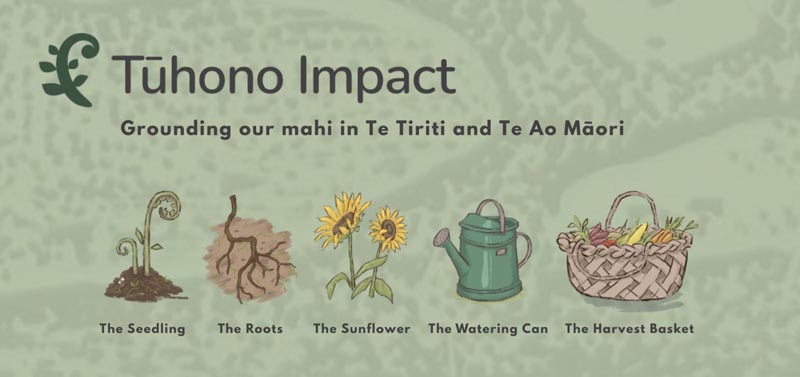 Tūhono Impact is a light-touch approach to understanding and communicating the wellbeing impact of creative spaces. It provides a shared language and simple tools to help spaces identify what matters, notice change, reflect on what they are learning and tell authentic stories about their impact.
It’s designed to support existing practice rather than add another layer of reporting or data collection.
Learn more about the Tūhono Impact
Grant Thornton’s report reflects the experience of creative spaces but there is one thing it can’t capture – how these organisations are particularly vulnerable because they fall between funding priorities.
Complexity of funding for creative spaces
A 2025 survey of creative spaces points to the complexity of funding at work: nine of the 24 responding spaces (37.5%) reported that at least one project received joint funding from two or more funders in 2025. Alongside this, conversations with Creative Spaces Network members indicate that most spaces rely heavily on short-term grants to sustain their work, with longer-term funding relationships providing greater stability for those that have them.
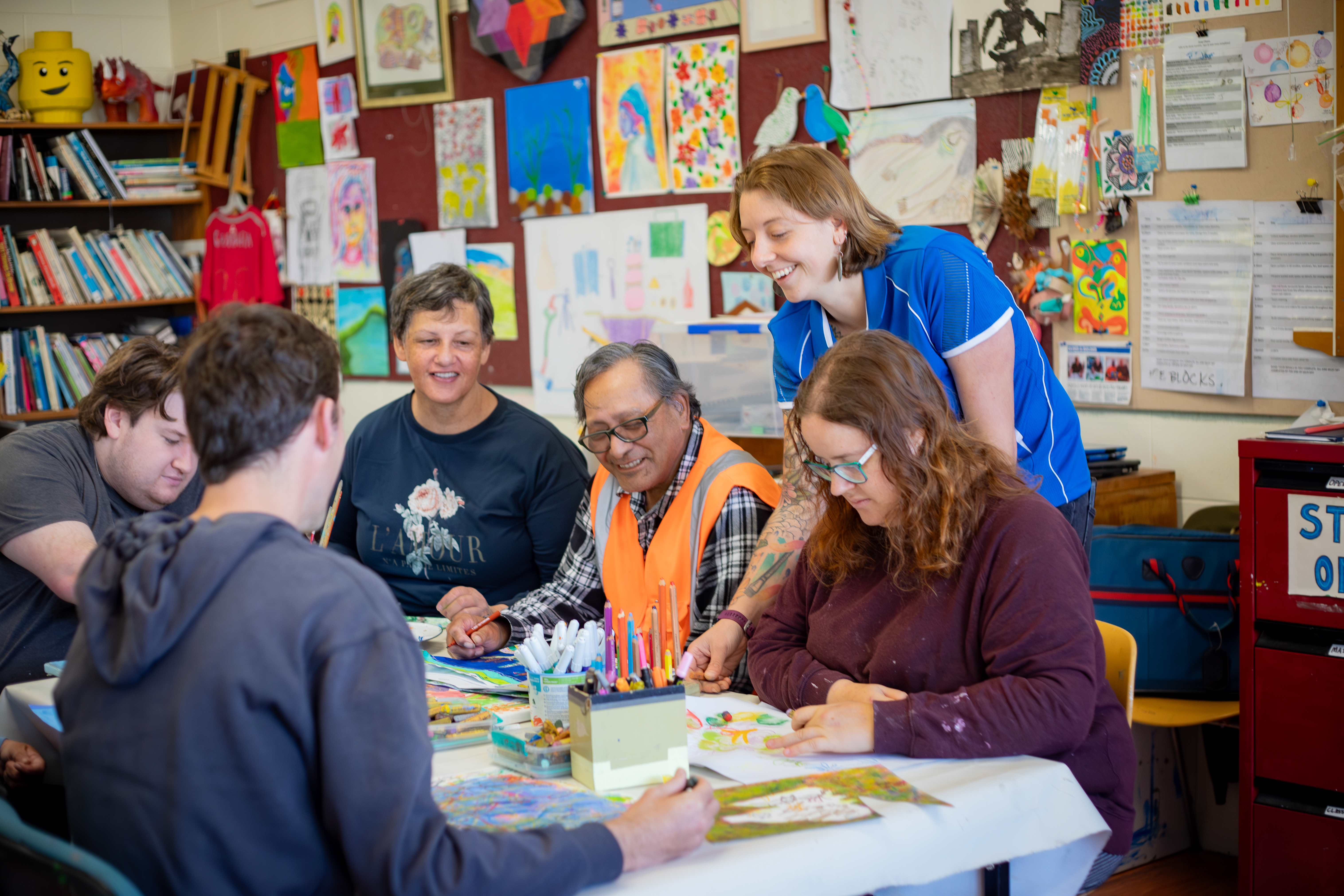 A creative space is a place where people with mental health distress, a disability or social isolation can make art, build connection and community, and be recognised as an artist. The work spans arts, health, disability, social inclusion and community development.
In practice, arts funders often see these spaces as health or social services while health funders see them as arts organisations. They fit everywhere in principle but nowhere in particular.
When funding tightens, organisations that sit squarely inside one priority have a clearer case than those spanning several priorities. Many small spaces run on a single paid staff member, a handful of volunteers and a patchwork of one-year grants.
For them, losing one funder can decide whether they open next year or close.
Creative New Zealand’s regional funding model, to be rolled out in 2027, will result in 16 regions distributing arts funding to local artists and arts organisations. It could be a real opportunity for creative spaces if the regional partners are resourced and mandated to fund creative spaces as core work.
Organisations simply can’t will resilience into existence
From my perspective, the report’s most useful insight is that organisations simply can’t will resilience into existence. Resilience depends on the right conditions; longer-term funding certainty; policy settings and investment in capability; meaningful impact measurement and support for governance; and a sustainable workforce.
For creative spaces to be resilient and able to meet the demand for their services, this means:
- recognition of creative spaces as essential community infrastructure, not project-by-project activity
- targeted, multi-year funding that covers the full cost of delivery, including fair wages
- a workforce investment plan for community arts, developed with creative spaces, so capability is built collectively rather than space by space
- regional funding through Creative New Zealand that explicitly includes community arts and creative spaces.
Creative spaces already do more with less. The question is whether we keep asking them to or invest in the conditions that let them thrive.